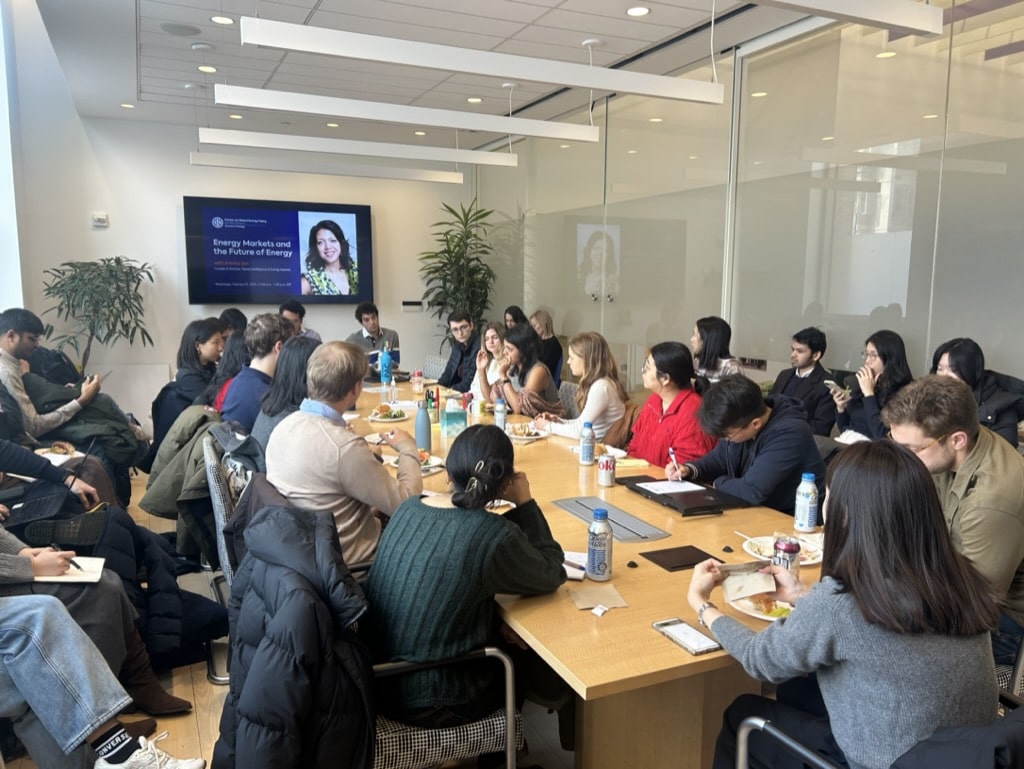
1. Building Confidence in the Workplace

    November 10, 2025 by

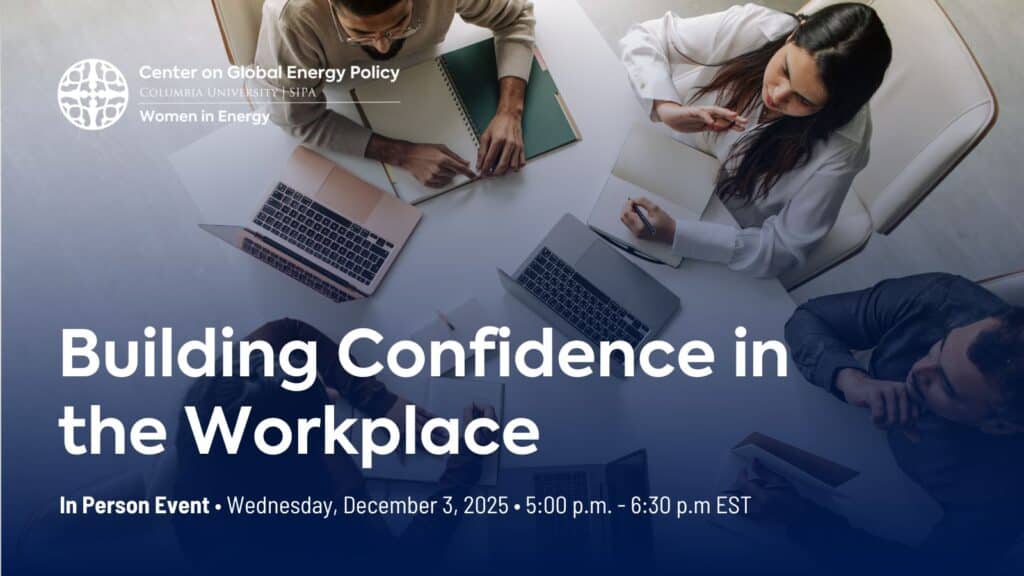
    The Center on Global Energy Policy at Columbia University SIPA’s Women in Energy initiative invites you to join us for an interactive workshop on building confidence in the workplace.

    During this session, participants will explore strategies to strengthen self-assurance, manage self-doubt, and communicate with clarity and presence. Through guided exercises and discussion, we’ll cover topics such as overcoming perfectionism, embracing your strengths, and developing practical habits that foster confidence in professional settings.

    Whether you are seeking to step into leadership roles, navigate new challenges, or simply show up more authentically at work, this workshop will provide actionable tools and insights to help you build and sustain confidence throughout your career journey.

    This session is designed to help you approach your professional growth with greater self-trust, resilience, and purpose.

  2. Career Search Strategies for International Students

    November 7, 2025 by Kyu Lee

    The Women in Energy initiative at the Center on Global Energy Policy, Columbia University SIPA, hosted an event titled “Student Roundtable with Career Coach Pam Brown” on Oct. 24, 2025. The event provided Columbia students the opportunity to engage directly with Pam, a seasoned career coach and leadership expert, for a conversation on searching and planning your career in today’s evolving professional landscape.

    The main questions and takeaways from the event are as follows:

    1. How should international students frame their career search strategy?

    The career path should be conceptualized as a “jungle gym,” not a ladder. The goal is to secure the best possible role given current circumstances, including the economy, life stage, and location. Play the long game by identifying career goals and acquiring the necessary skills to achieve them. Consider taking a “side gig” to make money while awaiting more desirable opportunities. Spend your time building and growing a network of contacts.

    2. What are the tactical steps for identifying and engaging companies that may sponsor?

    Look for job postings that explicitly mention STEM OPT, H-1B, or “visa sponsorship available.” A recruiter who proactively asks about your work authorization type (instead of dismissing the profile) is often a good sign. Companies that participate in university career fairs with a diverse talent focus (e.g., international student mixers) suggest a willingness to hire international talent. Focus on huge companies or very small companies, as these extremes are most likely to sponsor.

    Students can use resources like myvisajobs.com to see where people have been hired via CPT/OPT. (Curricular Practice Training/Optional Practical Training) Avoid any posting that specifies “Must be U.S. citizen or permanent resident” or “We do not sponsor work authorization now or in the future” or phrases like “No OPT/CPT, no H-1B transfers.” Ask directly to save time: “Can you share whether your company supports employment-based visa sponsorship for international students on F-1 OPT/STEM OPT?” Unless otherwise stated, it is recommended to assume the company does sponsor visas and proceed.

    3. How can students build meaningful connections through networking?

    Networking is centered on building relationships, not on immediately acquiring something. Start with warm leads, such as classmates, friends of friends, family, professors, or alumni. Use sincere flattery and genuine interest to initiate conversations, such as: “Your career is so impressive! I would love to ask you questions, see how you did what you did, etc.” If you meet someone briefly, send an immediate follow-up message (e.g., on LinkedIn) stating that you’d love to connect further and requesting 15 minutes to learn more about their background. Nurture the relationship by sending articles or notes about something that reminds you of them, such as sending an article about golden retrievers if they mentioned having one. Make use of university career offices (since students pay for them) and network with international student alumni.

    4. How should candidates market themselves when pivoting to a new role?

    Be authentic and be yourself, as this attracts people who will appreciate you. If applying to a role unrelated to your study field, you must “bridge the gap” for the recruiter. The recruiter is often looking for the most efficient way to make an appropriate hire, so you must make the connection for them. Use the specific “language” of the job description in your resume and, crucially, your cover letter. Clearly articulate your transferable skills.

    5. What common mistakes should international students avoid in the job search?

    Try to avoid the following: not engaging or speaking up due to concerns with language skills, being dishonest about citizenship, having too narrow a focus in the job search, and being “overzealous” or repetitive in professional interactions.

  3. Human Rights and Climate Change Post-COP 30

    November 5, 2025 by

    This event is open to Columbia University students only.

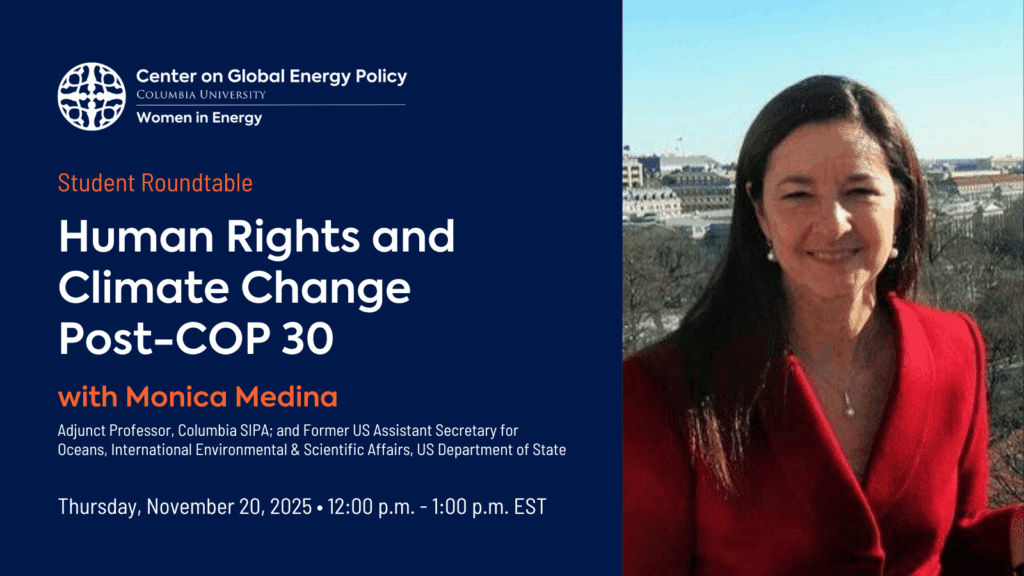
    Join the Center on Global Energy Policy’s Women in Energy initiative for an interactive discussion on human rights and climate change following COP 30 in Brazil. Monica Medina, SIPA Adjunct Professor and former U.S. Assistant Secretary for Oceans and International Environmental and Scientific Affairs, will share reflections from her time at COP 30 and examine how global priorities may be shifting from solely reducing emissions to addressing nature based solutions, communities, human suffering and adaptation.  

    The session will explore the growing debate within the climate movement about balancing mitigation with adaptation, equity, and public health, as well as the implications of recent international legal developments that hold major emitters accountable for global impacts.


    For more information about the event, please contact energypolicyevents@columbia.edu.

  4. Careers at the United Nations

    October 30, 2025 by Kyu Lee

    CGEP’s Women in Energy initiative hosted a virtual information session focused on career pathways at the United Nations, one of the world’s leading international organizations dedicated to promoting peace, human rights, and sustainable development. This event is presented in partnership with the DMUN Foundation and features a DMUN representative, Alexa Dominique Pascual, alongside a Human Resources specialist from the United Nations, Mahmoud Almasri. Together, they provided an overview of the UN’s mission, structure, and recruitment process, with a particular emphasis on current and upcoming employment opportunities. Attendees gained insights into the skills and qualifications the UN seeks in candidates, strategies for navigating the application process, and what it’s like to build a career in international affairs and global development.

  5. [Nov. 6] Networking with Intention: Advancing Your Career Through Relationships

    October 22, 2025 by

    Due to overwhelming interest, we are offering another session of this popular workshop! Join us on November 6th at 5:00pm for this interactive workshop on expanding and strengthening your professional network. Registration is required, and space is limited. Light bites will be served.

    The Center on Global Energy Policy at Columbia University SIPA’s Women in Energy initiative invites you to join us for an interactive workshop on professional relationship-building and networking.

    During this session, participants will explore strategies to strengthen and expand their professional networks through guided exercises and discussion. This workshop will cover how to create a relationship map, identify and cultivate new connections, and leverage existing relationships to achieve professional goals.

    Whether you are a working professional seeking to advance within your organization, a job seeker exploring new opportunities, or someone looking to expand your influence across the energy sector, this workshop will provide practical tools and insights to help you build meaningful and effective connections.

    This workshop is designed to help you take a more intentional approach to building relationships that drive career success.


    For more information about the event, please contact energypolicyevents@columbia.edu.

  6. [Oct. 30] Networking with Intention: Advancing Your Career Through Relationships

    October 10, 2025 by

    The Center on Global Energy Policy at Columbia University SIPA’s Women in Energy initiative invites you to join us for an interactive workshop on professional relationship-building and networking.

    During this session, participants will explore strategies to strengthen and expand their professional networks through guided exercises and discussion. This workshop will cover how to create a relationship map, identify and cultivate new connections, and leverage existing relationships to achieve professional goals.

    Whether you are a working professional seeking to advance within your organization, a job seeker exploring new opportunities, or someone looking to expand your influence across the energy sector, this workshop will provide practical tools and insights to help you build meaningful and effective connections.

    This workshop is designed to help you take a more intentional approach to building relationships that drive career success.


    For more information about the event, please contact energypolicyevents@columbia.edu.

  7. Student Roundtable with Career Coach Pam Brown

    by

    The Center on Global Energy Policy at Columbia University SIPA’s Women in Energy initiative invites Columbia University students to a roundtable discussion with Pam Brown, Managing Director at The Michaelis Group. 

    This roundtable will provide Columbia students with the opportunity to engage directly with Pam, a seasoned career coach and leadership expert, for an interactive conversation on searching and planning your career in today’s evolving professional landscape. 

    Pam will help participants consider questions such as: How do I pivot my career now that so much has shifted in the US economy? How can I talk about OPT during my job search? She will also offer advice on networking and strengthening personal marketing to support your job search.

    Join us on October 24 for an in-depth, student-only conversation. Registration is required, and space is limited.


    For more information about the event, please contact energypolicyevents@columbia.edu.

  8. Navigating Careers in Energy Finance

    September 29, 2025 by Kyu Lee

    The Women in Energy initiative at the Center on Global Energy Policy, Columbia University SIPA, hosted an event titled “Financing the Energy Transition”. The event was intended to facilitate a deeper understanding of energy finance, the professional opportunities available in that space, and how to access those opportunities. 

    The main questions and takeaways from the event are as follows:

    How do you prepare for the recruitment process?

    • Reach out to former employees of the organization, who can provide insights on the interview process, the company’s culture, and expectations around the hiring process.  
    • The recruitment process often involves a series of stages designed to assess both technical and interpersonal skills:
      • Personality Interview: Focused on understanding motivations, work style, and cultural fit.
      • Modeling Test: Designed to assess financial modeling skills.
      • Case Study: Designed to assess problem-solving, analytical, and presentation skills through a real-world financial scenario.
      • Interviews with Senior Professionals:  Intended to assess deeper knowledge of energy finance as well as strategic and long-term thinking.

    What are the key skills that early professionals in the energy finance space should focus on?

    Hard Skills:

    • Financial Modeling: building and evaluating financial models, especially in relation to risk-return assessments in energy projects.
    • Quantitative Analysis: Strong analytical skills to assess data and trends that impact investment and project decisions in the energy space.
    • Risk Management: Assessing, mitigating, and managing risks associated with energy finance.
    • Risk and Return Analysis: Ability to analyze investments from a risk-return perspective.
    • Industry Knowledge: Staying updated with the latest trends, technologies, and policies in energy finance by reading industry publications and newsletters, as well as attending relevant events.

    Soft Skills:

    • Open-Mindedness: Approaching problems from different angles and considering a variety of perspectives.
    • Humility: Acknowledging what you don’t know and being open to learning is essential.
    • Willingness to Learn: Openness to learning and adapting to new trends, technologies, and regulations in a fast-moving field.
    • Growth Mindset: Willingness to adapt to new challenges, such as changes in the market or new regulations affecting the energy industry.

    Advice for people transitioning into energy finance from different sectors

    For individuals without financial experience, the key is to:

    • Leverage Transferable Skills: Many skills from other sectors (e.g., policy, law, or engineering) can be applied in energy finance, such as critical thinking, problem-solving, and project management.
    • Demonstrate Adaptability: Showing potential employers that you can quickly learn new concepts and apply them to the specific needs of the energy sector.
    • Ask Questions and Be Curious: eProactively seeking knowledge and demonstrating a willingness to learn.

    What makes recruiting in the energy finance space unique?

    • Multidisciplinary Nature: Roles often require a blend of skills, such as private capital, investment, fundraising, capital markets, and an understanding of energy systems.
    • Diverse Roles: The energy sector encompasses many different roles, so understanding where your skills fit best is crucial.
    • Stakeholder Management: It’s essential to understand how different stakeholders (investors, governments, regulators, companies) interact with each other and how those dynamics influence investment decisions.

    What are the best ways to ensure a recruiter sees your profile?

    • Tailor Your Resume and LinkedIn Profile: These should reflect the specific role and be easy to read and keyword-optimized.
    • Leverage Networking: Most job placements in the energy sector come through referrals. Build strong relationships with professionals in the field.
    • Stand Out with Initiative: Going the extra mile to connect with recruiters (e.g., reaching out proactively or networking through events).

    How should early professionals explore and choose different roles in the energy finance space?

    • Apply Widely: Don’t be afraid to apply for a variety of roles across different companies and sectors within energy finance.  Job postings can be found through LinkedIn, Indeed, and company websites. 
    • Use Networking: Networking can help uncover opportunities that may not be publicly posted. Engage in coffee chats and seek informational interviews with professionals already working in the field.
    • Ask the Right Questions: When networking or interviewing, ask about what the company’s culture is like and whether the role will provide the kind of experience you need for career growth.

  9. Careers at the United Nations

    September 24, 2025 by

    Join us for a virtual information session focused on career pathways at the United Nations, one of the world’s leading international organizations dedicated to promoting peace, human rights, and sustainable development.

    This event is presented in partnership with the DMUN Foundation and will feature a DMUN representative, Alexa Dominique Pascual, alongside a Human Resources specialist from the United Nations, Mahmoud Almasri. Together, they will provide an overview of the UN’s mission, structure, and recruitment process, with a particular emphasis on current and upcoming employment opportunities.

    Attendees will gain insights into the skills and qualifications the UN seeks in candidates, strategies for navigating the application process, and what it’s like to build a career in international affairs and global development.

    This session is open to students and professionals interested in pursuing impactful careers that support peace, sustainability, and global cooperation.


    For more information, please contact energypolicyevents@columbia.edu.

  10. Exploring Energy Careers: Insights and Connections

    September 12, 2025 by

    *Registration is closed for this event.

    The Center on Global Energy Policy at Columbia University SIPA’s Women in Energy initiative, in collaboration with the Columbia Policy Institute, invites you to join us for Exploring Energy Careers: Insights and Connections —an evening of conversation and networking that highlights the breadth of opportunities across the energy sector.

    The program will open with a panel of speakers whose careers span law, policy, research, engineering, and finance, offering insight into the many ways professionals are shaping the industry’s future. After the panel, attendees will take part in small group discussions to ask questions, hear personal career journeys, and gather practical advice on navigating the field. Whether you are a student, early-career professional, or exploring a career transition, this event will provide valuable connections and perspectives. Join us to learn, engage, and discover the diverse pathways that drive today’s energy landscape.


    For more information about the event, please contact energypolicyevents@columbia.edu.