
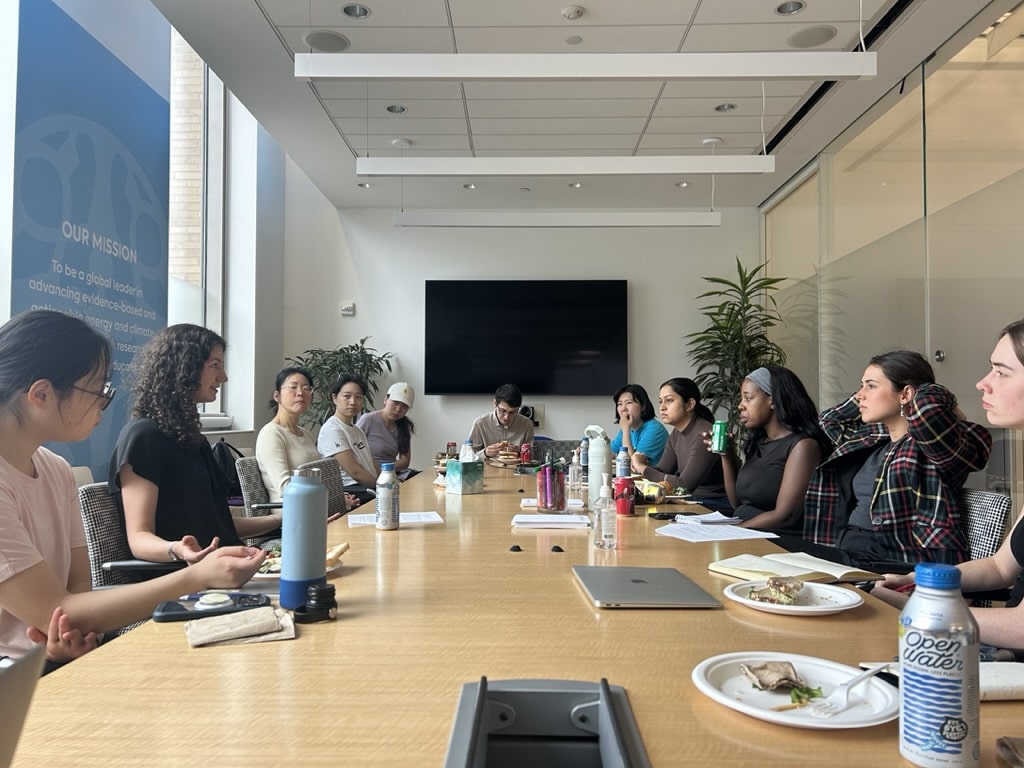
The Women in Energy initiative at the Center on Global Energy Policy, Columbia University SIPA, hosted a student roundtable on April 1 featuring Ann-Kathrin Merz, Industry and Strategy Lead at First Ammonia, with a focus on alternative fuels. The discussion, moderated by Columbia University student Julia Soncini Trevisan, covered the evolving market for hydrogen and ammonia technologies, career pathways in clean energy, and the realities of working at a startup.
Key takeaways from Ann-Kathrin Merz’s reflections on her career journey include the following:
- Career paths are shaped by timing, initiative, and strategic skill development. Merz transitioned from consulting at Boston Consulting Group to SIPA after recognizing the need to build technical credibility in the energy sector. Her academic experience, particularly her collaborative hydrogen research at the Center for Global Energy Policy, played a pivotal role in opening doors and ultimately connecting her with First Ammonia in its early stages.
- Relationships–and especially mentorship–play a critical role in career development. Building strong connections with professors, scholars, and industry professionals deepens one’s subject matter expertise and can directly lead to job opportunities, as their work reflects real-world priorities.
- Working at a startup offers breadth and accelerated learning. At First Ammonia, Merz’s role spans market intelligence, regulatory strategy, and power procurement, underscoring the need for adaptability and the ability to operate across multiple functions in startup environments.
Key takeaways from Merz’s remarks on industry dynamics and professional development include the following:
- Startups are both high-risk and high-reward environments. Success depends heavily on leadership’s ability to secure capital and strategically position the company within a broader ecosystem of established players.
- Gender dynamics remain a challenge, particularly in traditional energy sectors, where women often face higher expectations to prove technical credibility. However, the energy transition is creating new opportunities for greater inclusion, particularly in renewable and emerging technology spaces.
- In fast-evolving industries, initiative, adaptability, and curiosity are key to standing out. Having the perfect background is less important than a demonstrated willingness to learn, ask questions, and engage deeply with complex problems, as well as choosing supportive leadership and a work environment that champions your growth.
Key takeaways from Merz’s discussion of the hydrogen and ammonia sector and energy transition include the following:
- The hydrogen market is maturing rapidly, with fewer but more serious players. Early excitement has given way to a more disciplined focus on costs, engineering feasibility, and project execution, as investors evaluate projects using the strict financial and risk criteria typical of r large-scale infrastructure projects.
- Demand certainty is the central challenge to scaling clean fuels. Long-term offtake agreements are essential for project financing, but are difficult to secure if the policy landscape that supports them appears unstable and likely to change in the near term. The sector demonstrates the importance of policy continuity.
- Offtake opportunities are available in sectors that are brand-conscious and able to pay a premium, as well as in sectors driven by national security priorities such as food security (e.g., domestic fertilizer production in a country like India, which has strong renewable sources but a persistent and potentially risky dependency on foreign natural gas).
- While technological innovation is advancing, scaling these solutions depends on aligning policy, financing, and market demand. These factors–each dependent on a stable policy environment–are the bottleneck, not innovation. Many promising innovations exist, but only a limited number will reach commercial deployment.